When Agents Can Build, What Will We Compete On?
My reflections from Oracle AI World 2026, and why I believe enterprise transformation is entering the era of the design competition.

Twenty-one years ago, I was working on a Hyperion 7.x implementation for a hospitality company.
This was 2005. Long before generative AI, copilots, AI Agent Studios, and autonomous enterprise applications became part of our everyday vocabulary. Yet we were already trying to solve a surprisingly familiar problem.
We built Linux-based automation around Hyperion that could evaluate master data relationships as part of processing. It could sort members and evaluate parent-child relationships. If incoming master data did not have a valid parent, the automation could recognize the exception and place the member beneath a designated stub parent rather than simply allowing the process to fail.
It monitored data loads, captured exceptions, and notified the appropriate stakeholders by email. We built exception handling for runtime problems, calculation failures, and other processing issues. In other words, we were trying to make the system:
Sense what was happening → determine whether it was expected → take a predefined action → involve a human when necessary.
Was that artificial intelligence by today's technical definition? Probably not. But from the perspective of someone using the system, many of the outcomes would sound remarkably familiar today.
The fundamental difference was this: we had to anticipate the conditions and explicitly engineer the response. We weren't describing an outcome and allowing the system to determine how to accomplish it. The intelligence predominantly existed in the design and in the people encoding that design.
That distinction has been on my mind since returning from Oracle AI World 2026. Because what I saw there suggests something much bigger than AI-assisted productivity is beginning to happen.
From scripts to intent
 Open full-size image
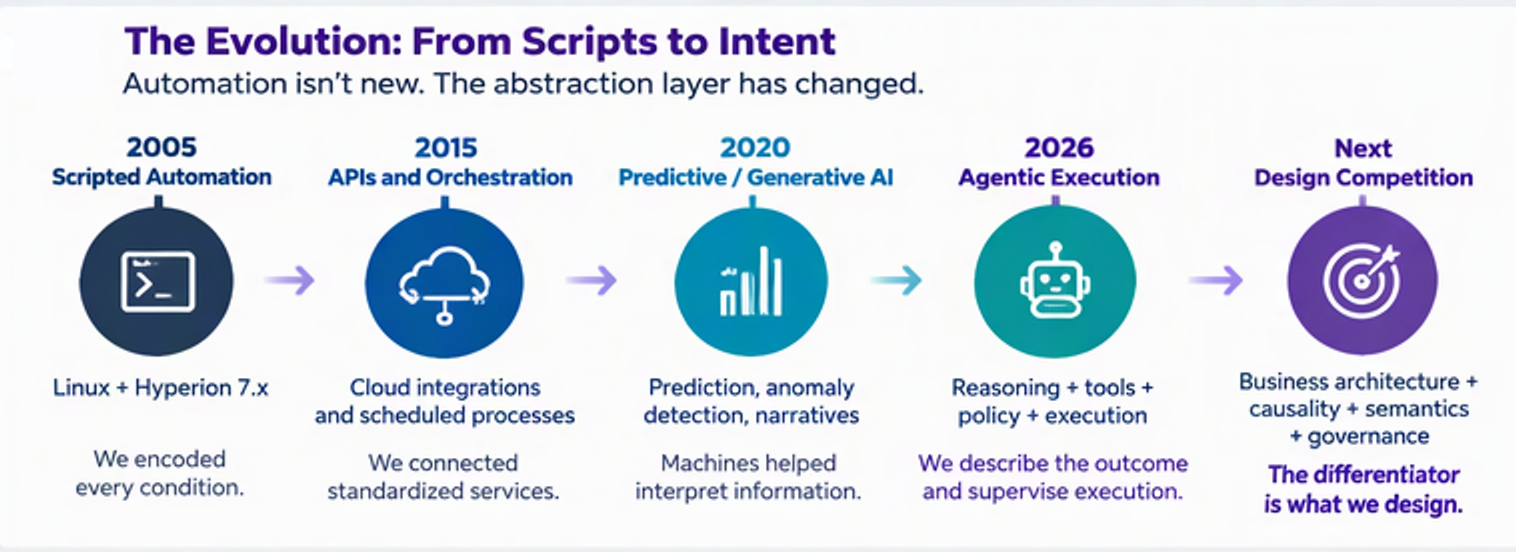
Automation isn't new. What is changing is the abstraction layer at which humans interact with automation.
- In 2005, we encoded individual conditions.
- Later, APIs allowed us to connect standardized services.
- Predictive and generative AI helped machines interpret information.
- Now agents increasingly allow us to describe the outcome, provide them tools, establish guardrails, and supervise execution.
The destination hasn't changed as much as the path has.
The agents are coming
At Oracle AI World 2026, I presented “The Agents Are Coming: Is Your Oracle EPM Platform Ready?” My premise was that Finance is progressing through another fundamental change in how people interact with enterprise technology.
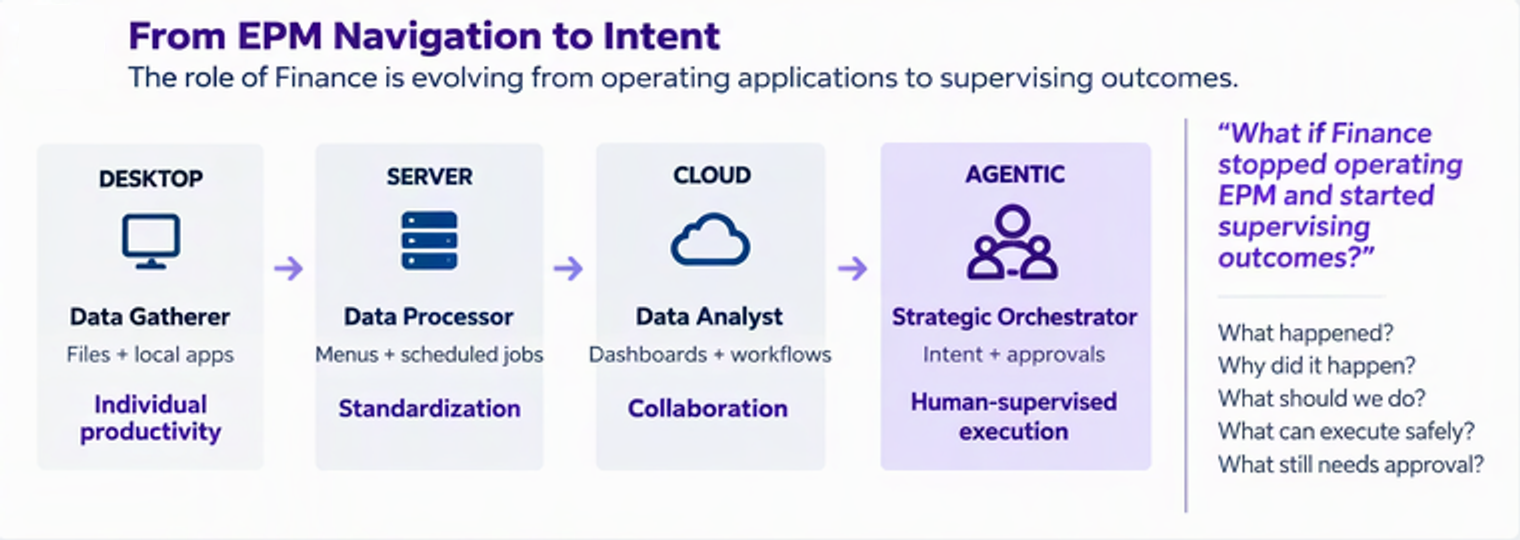
We have moved through generations where Finance professionals acted primarily as Data Gatherers → Data Processors → Data Analysts → Strategic Orchestrators. The agentic era introduces the possibility that Finance increasingly supervises outcomes rather than operating applications.
 Open full-size image
The question begins changing from “Where is the form I need to update?” to “What happened?” — and then “Why did it happen?” — and ultimately: resolve the exceptions, evaluate the scenarios, recommend the best course of action, and tell me what requires my approval.
The next interface to EPM may increasingly be intent.
But after seeing the direction of several announcements at AI World, I think there is a second, potentially bigger implication. Intent isn't only becoming an interface for using enterprise applications. It is beginning to become an interface for building and operating them. And that changes what we will ultimately compete on.
What actually changed at AI World?
Several developments caught my attention — not individually, but collectively.
AI Agent Studio: assembling capabilities around outcomes. Oracle AI Agent Studio increasingly provides the ability to assemble agents, tools, workflows, applications and enterprise capabilities around business outcomes. That matters because the boundaries of a Finance question rarely align neatly to the boundaries of an application.
Take a revenue forecast variance. The forecast and target might reside in EPM. Actual revenue may originate in ERP. Pipeline lives in CRM. Workforce information could live in HCM. Usage, customer retention, supply, billing or operational information may reside somewhere else entirely. Why should the investigation stop because the next piece of evidence sits outside the EPM application?
In an agentic architecture, the business question defines the journey.
Fusion Claw: moving from assistance to execution. Oracle describes Fusion Claw as a governed agentic execution runtime that can reason, compute, adapt and execute complex work. People define objectives, authority and accountability; agentic applications coordinate toward the outcome within those parameters.
Oracle documentation goes one level further: a user can describe a business outcome in natural language, after which Fusion Claw can analyze the objective, consider constraints, develop a plan, perform authorized actions, monitor progress and adjust the plan as conditions change. That distinction matters:
- Reason where intelligence is required.
- Use deterministic computation where precision is required.
- Execute within clearly defined authority.
Oracle is already applying this model to areas such as close readiness, account variance analysis, collections and gross-margin investigation. This isn't simply “ask AI a Finance question.” It is moving toward giving the system responsibility for pursuing an outcome, while explicitly governing its authority to act.
And then there is FSCR
This may ultimately be one of the AI World announcements I find most consequential. Oracle Fusion Setup and Configuration Registry, or FSCR, makes Oracle Fusion setup and configuration knowledge machine-readable and executable by AI agents. Oracle says its AI skills capture configuration options, dependencies, sequencing, execution, testing and validation.
It can take requirements and structured inputs, help map them to setup tasks, create dependency-aware implementation plans and runbooks, and support approved configuration and validation activities. Oracle is also appropriately explicit that FSCR does not automatically configure an entire implementation. Consultants remain responsible for requirements, approvals and determining whether the resulting configuration meets business needs.
My practice at Grant Thornton was one of the Partner Pilot participants for FSCR. We observed as one of our practitioners used one of roughly 1,000 FSCR skills to complete initial environment setup across HCM and ERP, and connected multiple environments simultaneously to compare configuration, to name just a few of the experiments carried out in the pilot program.
And, to me, that's exactly where the story becomes interesting. Implementation knowledge that historically lived across product specialists, documentation, methodologies, configuration workbooks and years of experience can increasingly be expressed in a form machines can understand and act upon. Which raises a fundamental question:
If agents increasingly know how to build, what will humans compete on?
From implementation competition to design competition
 Open full-size image
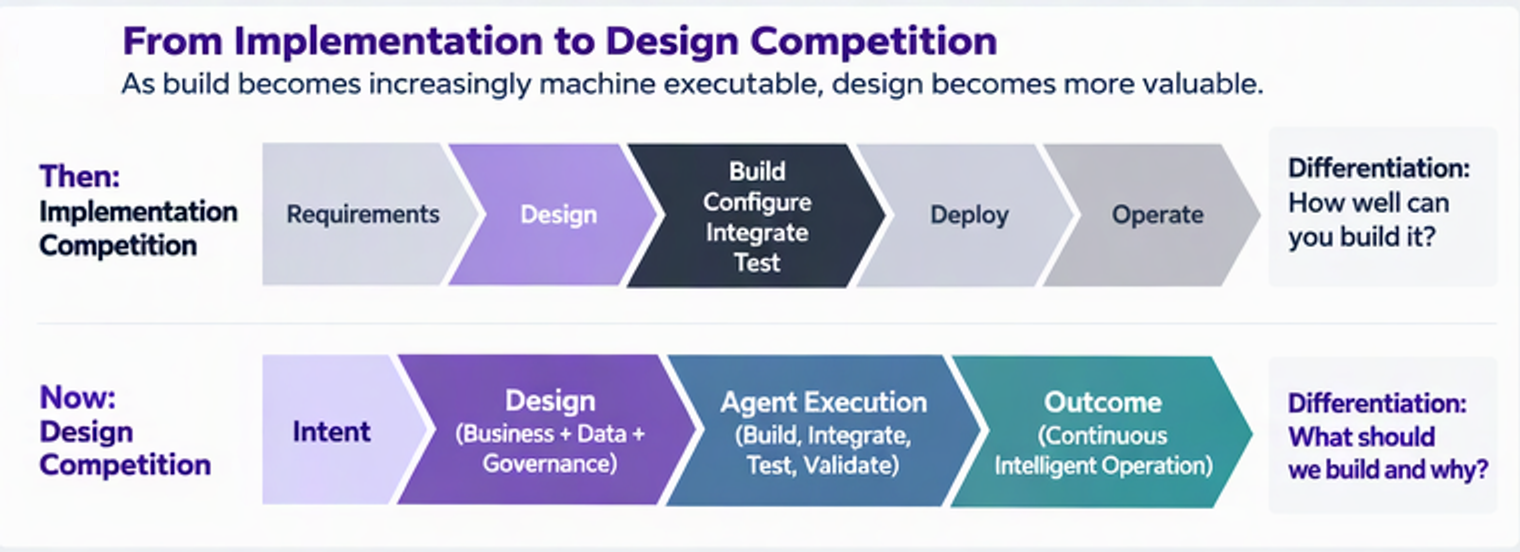
This is the point where I believe enterprise transformation begins entering a design competition. For much of my career, one of the major differentiators in enterprise technology has been the ability to build. Who understands the product? Who knows how to configure it? Who can design the dimensional architecture? Who understands Essbase? Who can build the integrations, optimize calculations, migrate the data, automate the environment, and test and deploy it efficiently?
Those capabilities aren't becoming irrelevant. But agents will progressively absorb portions of that differentiation. If an agent can understand product configuration, generate implementation steps, invoke APIs, validate outcomes, identify failures and potentially remediate issues, implementation knowledge becomes dramatically more scalable.
And when execution becomes more abundant, something else becomes scarce. Great design.
The question evolves from “How efficiently can you build what I specified?” to “Can you design a fundamentally better way for my organization to operate and make decisions?” That's the design competition.
EPM 26.11 makes this particularly interesting
For those of us who live in the Oracle EPM world, the November 2026 release adds another important signal. Among the developments in the Oracle Fusion Cloud EPM 26.11 update are EPM agent skills for areas such as core infrastructure administration and platform data exploration, additional REST API capabilities, OAuth 2.0 support between environments, an IPM Insights Assistant, and generative-AI-oriented insight analysis.
The REST API expansion is particularly important. Why do APIs matter in an AI conversation? Because agents need tools. An agent can reason that it needs information from Planning, needs actuals from ERP, needs to run a calculation, retrieve an insight or evaluate a scenario. But reasoning alone doesn't perform the work.
Governed APIs, services and agent skills translate reasoning into action. And that changes the architecture we should be designing.
Bring intelligence to the data
 Open full-size image
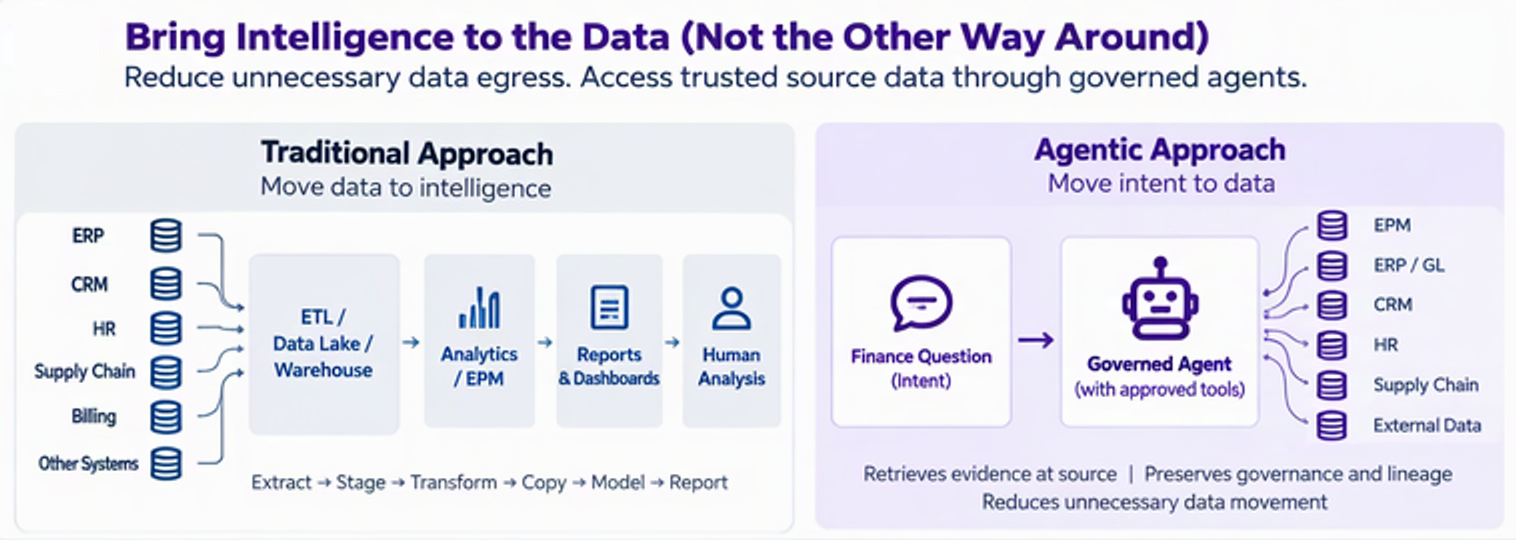
That distinction matters enormously. We've spent decades moving enormous amounts of enterprise data around. Extract it. Stage it. Transform it. Load it. Copy it. Aggregate it. Move it somewhere else for reporting.
Some of that will remain necessary. Planning, consolidation, dimensional analytics, statutory processes, scenario modeling and performance requirements all create legitimate reasons to persist and transform data. But AI gives us reason to challenge the assumption that every new question requires another copy of the data.
Can we bring intelligence to trusted source data, rather than moving every piece of source data to wherever intelligence happens to live?
Imagine asking: Why is EBITDA forecast below target? Perhaps an agent starts with forecast and target in Oracle EPM. It discovers the variance is revenue-driven. It accesses actuals from ERP. It examines bookings and pipeline in CRM. It looks at retention or usage. It evaluates workforce or supply constraints. It returns the evidence, the causal explanation and several potential actions.
The objective becomes data proximity with governance:
- Retrieve evidence at source where appropriate.
- Preserve lineage.
- Maintain context.
- Reduce unnecessary data egress, replication and latency.
That becomes a design decision, not simply an integration decision.
Causality, not just correlation
This may be one of the areas I find most exciting for EPM. Traditional reporting answers: What happened? Better analytics answers: Where did it happen? The next architecture needs to keep going: Why did it happen? And ultimately: What action could change the outcome?
Consider our EBITDA example. Seeing the variance isn't enough. An intelligent Finance architecture should traverse its potential causal chain:
- Revenue → bookings → pipeline → conversion → usage → churn → pricing
- Margin → volume → mix → labor → utilization → input cost
The objective isn't simply to discover which numbers correlate with the variance. It is to identify which relationships matter enough that changing something changes the outcome.
Once those causal drivers emerge, Finance can evaluate scenarios. What happens if pricing changes? What happens if volume recovers? What happens if costs are constrained? What happens to cash? What happens downstream?
That moves EPM beyond being simply a destination for consolidated information. It becomes part of a decision architecture connecting financial outcomes to their operational causes.
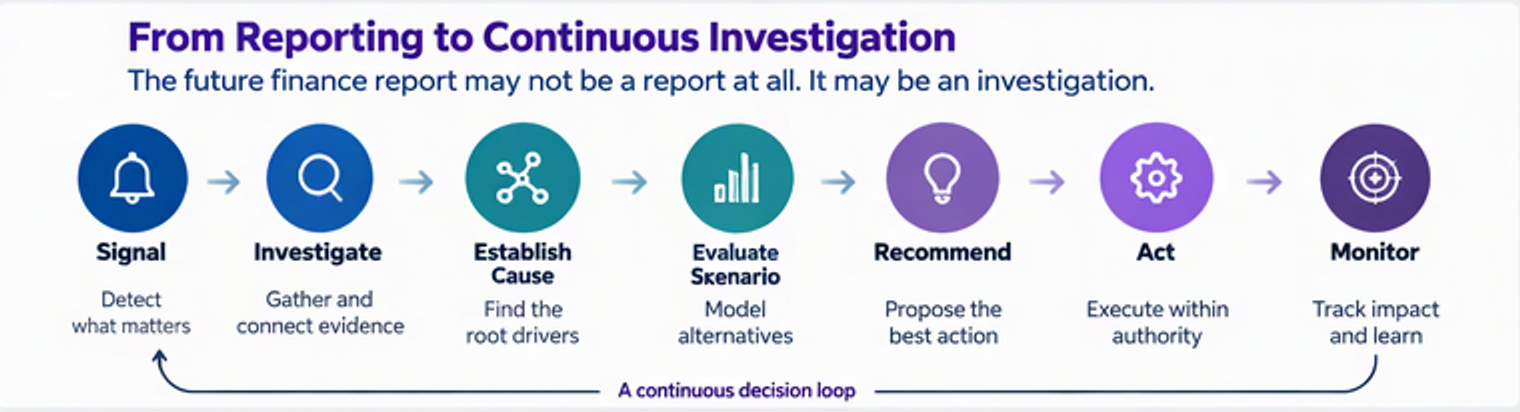
From reporting to continuous investigation
 Open full-size image
This model changes another concept we've taken for granted for decades: reporting. We built reports. Then better reports. Then interactive dashboards. Then mobile dashboards. Then visualizations. Then narrative explanations.
But consider the logical conclusion of agentic reporting. Why should someone continuously watch a dashboard hoping to notice that something important happened?
What if the system recognizes that the EBITDA outlook has materially changed? Then investigates why. Connects evidence across systems. Establishes the likely causal drivers. Runs scenarios. Recommends an intervention. Requests approval where necessary. Executes within delegated authority. Then monitors whether the expected result actually occurred — and then it repeats.
The future Finance report may not always be a report at all. It may be a continuous investigation that surfaces itself when human judgment is actually required.
Reports don't disappear. They become evidence within a larger decision process.
So what will we compete on?
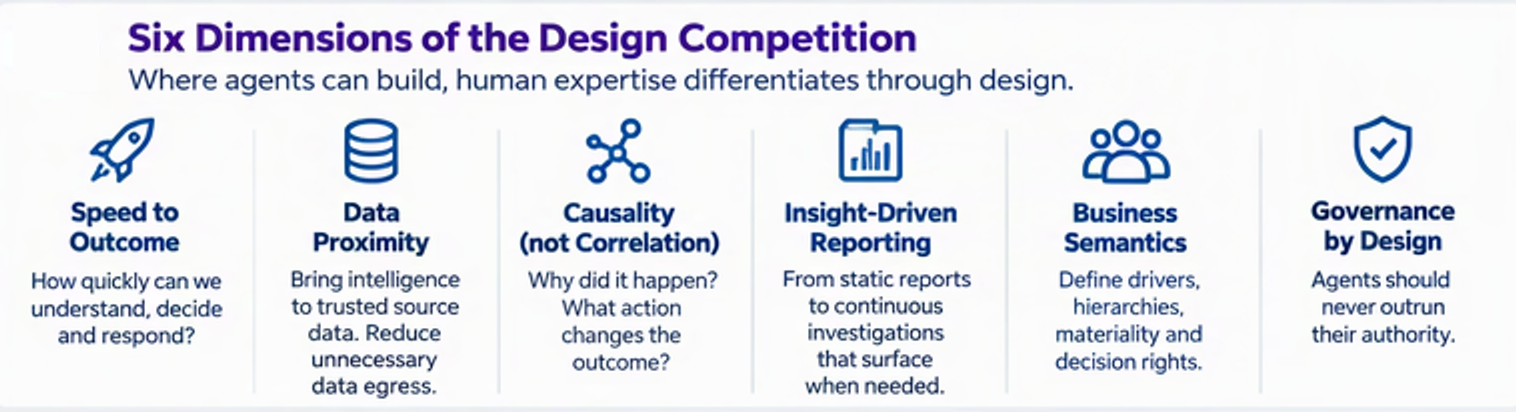
I see at least six dimensions.
 Open full-size image
1. Speed to outcome. Not “How quickly can we configure Planning?” Instead: How quickly can the organization recognize change, understand its implications, evaluate alternatives and make a better decision? Time-to-decision becomes as interesting a transformation metric as time-to-deploy.
2. Data proximity. Don't automatically bring every piece of data to the AI. Where appropriate, bring governed intelligence to the source. The architecture needs to balance performance, persistence and analytics requirements with reducing unnecessary movement, replication and egress.
3. Causality, not just correlation. Don't stop at “What changed?” Keep asking “Why did it change?” and then “What could we change to influence the outcome?” That difference separates interesting analysis from actionable intelligence.
4. Insight-driven reporting. Reporting evolves from presenting information toward initiating decisions. Instead of Dashboard → Human interpretation, we move increasingly toward Signal → Investigation → Explanation → Scenario → Recommendation → Action. The report becomes part of the evidence chain.
5. Business semantics. This may be the paradox of the agentic era. As technology becomes easier to execute, business understanding becomes more important, not less. Someone still has to understand:
- What is material?
- What constitutes an exception?
- What actually drives revenue?
- Which hierarchy correctly represents the organization?
- Which metrics influence decisions?
- What is controllable?
- What relationship is causal rather than coincidental?
- Which action should be taken — and who owns that decision?
An enormously capable agent operating against a poorly designed business model simply gives us the ability to execute a bad design faster.
The hard problem moves from teaching software where to click toward teaching the architecture how the business actually works.
6. Governance by design. Finally, an agent should never outrun its authority. Who can instruct the agent? Which information can it retrieve? What can it calculate? What can it change? What materiality thresholds apply? When does it require approval? Which actions require segregation of duties? What evidence must be retained? When should it stop and ask a human?
Fusion Claw is designed around precisely this idea of defined levels of autonomy, organizational policies, permissions, approval requirements and auditable execution. Governance therefore isn't something we bolt onto an agent after we've built it. Governance is part of the design.
What should Finance organizations do now?
I don't believe the answer is to launch 100 disconnected AI experiments. Start with a decision. Pick an important Finance question that takes too long to answer today. For example:
Why are we projected to miss EBITDA target next quarter, and what is the least disruptive action that could close the gap?
Then work backward.
- Map the evidence. Where does the answer actually live — EPM, ERP, CRM, workforce systems, billing, supply chain, operational systems, external information?
- Define the causal model. What relationships must be investigated before an answer becomes actionable?
- Expose governed capabilities. Which APIs, agent skills and enterprise tools should agents be permitted to use?
- Establish decision rights. What can an agent Observe → Investigate → Recommend → Execute?
- Determine where humans add judgment. Human-in-the-loop shouldn't mean placing an approval button at the end of everything. Identify where materiality, accountability, ambiguity and judgment truly require human involvement.
- Measure time-to-decision. Don't only ask how many hours AI saved. Ask whether we materially reduced the time between detecting a business condition and making a well-supported decision about it.
That is a much more interesting measure of Finance transformation.
Twenty-one years later
And that brings me back to the Hyperion implementation I started with. In 2005, we were trying to make a system capable of detecting conditions, executing repetitive work, responding to exceptions and involving people when something required attention. Twenty-one years later, many of those objectives sound surprisingly similar.
But the division of responsibility between the designer and the technology is changing. In 2005, we designed the destination and painstakingly engineered virtually every turn required to get there. In the agentic era, our job increasingly becomes to:
- design the destination,
- design the business semantics,
- design the evidence,
- design the causal relationships,
- design the guardrails,
- and design the decision rights,
while allowing agents to determine more of the journey.
That doesn't diminish the importance of deep EPM, Finance, industry, process, data and technology expertise. I think it makes those skills more consequential. Because if agents progressively become better at how to build, our differentiation increasingly becomes: What should we build? Why should we build it that way? And what fundamentally better business outcome should that design enable?
When execution becomes abundant, design becomes scarce
That may ultimately be my biggest takeaway from Oracle AI World 2026. Yes, the agents are coming. But the more interesting question isn't whether agents will become capable of performing work that humans previously performed. They will.
The more interesting question is: what will we ask them to build?
The organizations and practitioners who differentiate won't simply be those who automate the most. They will be those who can design better systems for turning Trusted Data → Understanding → Causality → Decisions → Governed Action → Better Outcomes.
And that is why I believe the next era of enterprise transformation will increasingly become a design competition.
The question is quickly moving beyond whether Finance will use agents. The question is whether we are designing our Finance architecture, data, processes, governance and people for what happens when those agents arrive.
The agents will build. What we choose to compete on is still ours to design.
Written by
Vatsal Gaonkar
Finance & AI Transformation Advisor · Oracle ACE Director
Vatsal Gaonkar is a Finance & AI Transformation leader with more than two decades spent aligning people, process, and technology. An Oracle ACE Director and advisor to C-suite executives, he writes about Autonomous Finance, agentic AI, and what he calls Abundance-Based Leadership and the Infinite Improvement mindset — treating innovation as a journey rather than a destination.
Connect on LinkedInKeep reading Volantis
New essays straight to your inbox. No noise, no ads — just the argument.